Moon Valley theater program: More than a club
April 5, 2026 by Danielle Jennings, Arizona State University

Danielle Jennings is an ASU Cronkite School of Journalism student assigned to cover Moon Valley High School for AZPreps365.c9om
Singing, dancing and acting. Components of what goes on in a theatre program.
But that is not all what happens. There’s more to the program. Or, in this case, more to the story.
At Moon Valley High School, the program has a long-standing history, likely dates back to the school’s early years. While Moon Valley’s theater director Ryan Kitkowski said he didn't know the exact founding date, he noted that the school’s Thespian troupe number is 15 — an indication it was among the first established in Arizona. A Thespian troupe number is given to a school by the International Thespian Society due to the school being an active chapter of the ITS and students participating in the chapter.
Now, however, the focus is less on history and more on recovery and growth.
“I took over this program in September,” Kitkowski said. “It was after the previous teacher unexpectedly resigned, so it’s been kind of a whirlwind.”
The sudden transition created challenges, especially with time management. Kitkowski described balancing the demands of the theater program, while also being a teacher and having a personal life, as challenging. Like many arts programs, Moon Valley’s theater department was heavily impacted by the COVID-19 pandemic. When classes moved online, participation dropped significantly.
Since returning to in-person learning, the program has slowly begun to recover. A new group of freshmen have joined, bringing renewed enthusiasm.
Moon Valley’s theater program’s primary source of funding is ticket sales. To attract audiences, the program has focused on outreach efforts, including school announcements, posters and inviting middle school students to preview performances. These strategies are designed not only to boost attendance but also to inspire younger students to want to join theater in the future. They use the money toward costumes and set designs.
“We try to market as best we can,” Kitkowski said. “Bring in as many people as possible.”
Despite these challenges, the program continues to have a strong impact on students. Kitkowski and another theater program director, Johnathan Peters, described theater as a “place where students can express themselves” and step outside of their comfort zones.
Moon Valley senior Niko Christensen said the program has had a big impact on him.
“I’ve made the most friends in the theater program,” Christensen said. “Theater is honestly the best place to make the best friends.”
Christensen also emphasized the supportive environment created by the directors, who encourage both creativity and collaboration. Kitkowski and Peters not only guide the students, but also give them a voice in the creative process, making the experience more engaging and inclusive.
For Peters, working with students is one of the more rewarding aspects of the job. Theater offers a different perspective compared to traditional classrooms, allowing students to fully engage in something they are passionate about.
“You get to see them in their element,” Peters said.
That passion is what keeps the program moving forward. Moments such as opening night at the spring play, Attack! Of The Killer Man From The Sun, in February served a reminder of why the effort matters. After weeks of rehearsals and preparation, Peters and Kikowski said seeing students perform in front of a live audience stands out as a defining experience.
“Just seeing it all come together, that’s a great feeling,” Kitkowski said.
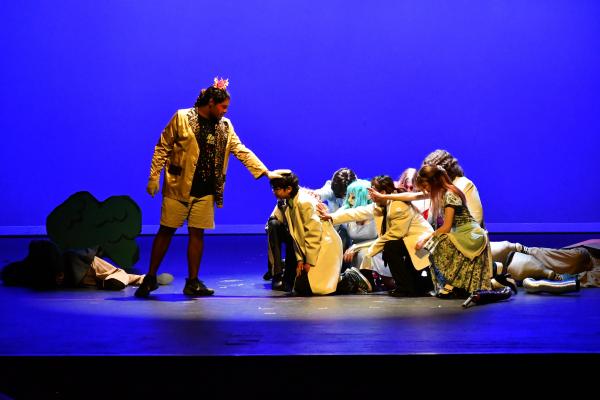 Participation in Moon Valley’s theater department decreased during the COVID-19 pandemic. But the program is recovering. (Photo courtesy of Ryan Kitkowski)