Arizona's high school pipeline to the pros
May 6, 2026 by Harry Kaseff, Arizona State University

Harry Kaseff is an ASU Cronkite School of Journalism graduate student assigned to cover Corona del Sol High School for AZPreps365.com
Arizona high schools don't produce professional athletes by accident, they build them.
Under the desert sun, where year-round training meets relentless competition, the Grand Canyon State has placed itself in the top half of producing the most pro athletes in the country. While powerhouses like California, Florida and Texas lead the way from coast-to-coast, Arizona’s profile is more precise than prolific.
Across more than four decades a clear pattern has emerged: the path from high school fields to professional leagues is most commonly found in a small group of high schools. While thousands of athletes have competed at Arizona high schools since 1980, only 202 have reached the pros. When they do, their roots tend to trace back to the same select programs, where development isn't coincidence, it’s culture.
"My ultimate goal isn't something that can be measured this year or next year,” said Jason Jewell, Brophy Prep football coach. “It's stuff that can be measured 10 and 20 years down the road. Do you have successful fathers and successful husbands?”
Brophy has produced six NFL players since 1980, including Ben Morrison whom Jewell personally coached and is now a cornerback for the Tampa Bay Buccaneers. JJ Jansen, longtime long snapper for the Carolina Panthers, was a Brophy Bronco, as was New York Giants defensive back Isaiah Oliver.
Professional athletes from Arizona tend to play in the NFL or MLB. Arizona’s climate allows for year-round development. The structure surrounding both sports, from youth leagues to college recruiting, has created a direct line from high school programs to professional leagues.
“You create a great atmosphere, and people want to come play for you because you're developing all these future college guys,” said Philip Wright, former Canyon del Oro baseball coach (1987-1998). “People want to be a part of winning programs."
Another factor of the situation is the comparison between public and private high schools. You might think that private schools would have the ability to produce more pro athletes, but that is not the case.
Public schools outrank private schools, 14-to-2, in the top 16 schools. Brophy has produced the most pro athletes out of private schools since 1980. However, they are tied for third when considering public schools.
Data clearly shows trends in which high schools are producing the most pro athletes. A relatively small group of high schools accounts for a lopsided share of Arizona’s professional athletes. These are programs that have produced, reloaded and produced again, creating something closer to a pipeline than a coincidence.
The numbers outline a trend that shows where pro athletes from Arizona are most frequently to start, and how those pathways have taken shape over time.
Chaparral High School in Scottsdale leads the state with 17 pro athletes since 1980. The Firebirds have set the standard for sustained success. Chaparral is one of several schools that have come to define Arizona’s pipeline to the pros.
“I think the tradition of Chaparral athletics is to set the bar high,” said Jack Bagley, Chaparral’s athletic director. “The expectations are to compete at that level and anything short of that is kind of a letdown or disappointment.”
Chaparral has produced nine MLB players, seven NFL players and one Olympian since 1980.
Successful coaches hold their student athletes accountable on and off the field. The best players are oftentimes the best students and people.
"Our number one standard for our team is having a genuine concern for the success of our football team,” Jewell said. “It doesn't mean putting your team first. It just means how do your actions affect your football team?"
Players at prestigious high schools are chasing greatness that precedes them.
"We don't call it rules. It's the standard that we live by,” Jewell said. “It's really silly, but I just tell the kids, I say it exactly like this, so don't laugh at me. ‘So it's never, ever, ever, ever, ever lie. You can't lie, period. If you lie to me, then how am I going to gain that trust with you? If you lie to your teammates, how do you gain that trust?’"
Private vs. Public high schools
There are only two private high schools that have produced at least 10 pro athletes since 1980. St. Mary’s has produced 10 and Brophy Prep has produced 15 pro athletes.
Brophy has trained six future NFL players, three MLB players, two PGA players and one NBA, MLS and Olympic athlete.
“Like this school, Brophy, our kids choose to come here a lot of the time,” Jewell said. “With some of the public schools, it's just your neighborhood school, and it's just where you go. They choose, but I don't choose them.”
St. Mary’s has produced its best athletes across fewer sports than Brophy. The Knights produced four NFL players, three MLB players, two NBA players and two WNBA players.
The field is much more dense for public schools. Modern transfer rules have aided high schools to attract the best players to their prolific programs.
“It all started with the open enrollment rule in Arizona where you can go anywhere you want,” said Seth Polansky, Director of Media Services for the AIA.
“In summertime, you're playing in camps and travel ball. You might see another coach, find out where they're from, and then realize you have open enrollment and you can, if you're willing to drive a little extra, go to a school where there's a coach that may be perfect for you and the academics line up for you.”
Chaparral has cultivated 17 pro athletes from 1980-2020. That is almost one pro athlete every two years.
“The competition level that we have in our district and our region is really high,” Bagley said. “It makes it that much more challenging, but it pushes us to be our best.”
The Firebirds play in many tournaments around the country where they face the best of the best.
“Our head coaches are always putting our teams in tournaments that have nationally ranked teams just so that we can play that upper level,” Bagley said.
Whether it’s a USA Baseball tournament in North Carolina or a basketball tournament in Las Vegas, Chaparral always wants to compete with the best.
“I always said to be the best, you have to beat the best,” Bagley said.
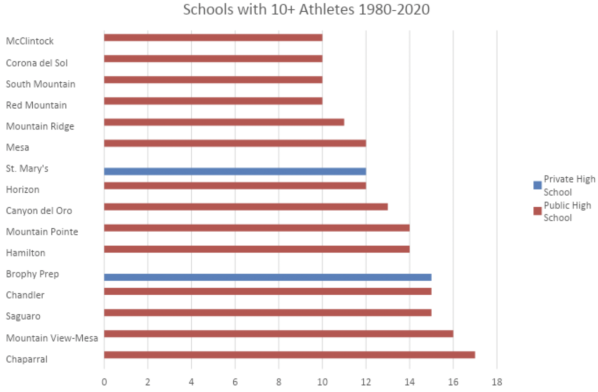 Bar chart representing the 16 high schools in Arizona that have produced the most professional athletes from 1980-2020.
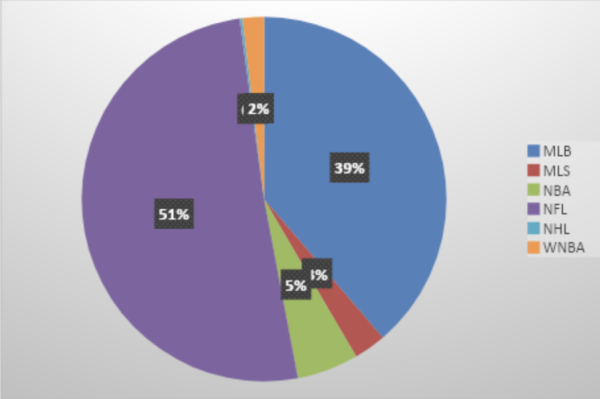 Pie chart showing the spread of pro athletes from Arizona between the six major professional American sports leagues.
Brophy Standard Time
The culture and standard at Brophy Prep stands out compared to the field. Their success has spanned multiple coaches and decades.
Going back to the 1980s and 1990s, Tim Sanford was the coach of the Brophy football team. The longtime assistant and influential coach started this run of Bronco dominance. Sanford won three Arizona Coach of the Year awards developing student athletes on and off the field during his tenure as Brophy’s football coach.
Scooter Molander led the Broncos to the only two state championships in school history from 2005 to 2017. Molander stepped down at the end of the 2017 season.
“Coach Molander won a lot of games here, and he is the winningest coach in school history,” Jewell said.
Former NFL quarterback Jon Kitna took over for the 2018 season before Jewell took over in 2019. Jewell introduced Brophy Standard Time (BST) to his team in 2021.
“We call it BST: Brophy Standard Time. It's just about being on time. That's a huge life lesson, showing up on time, not just on time, but early,” Jewell said.
BST ensures that athletes are being taught discipline and are holding their teammates accountable.
“We say BST means you have to be at practice 15 minutes early,” Jewell said. “You have to be in class, five minutes early. You have to be in the weight room five minutes early. I think if you can do that, you can solve a whole lot of your problems in everyday life just by being on time.”
Jewell is 45-34 overall and 16-12 in region since he became the head coach. Brophy has finished as the sixth best team in Arizona for two consecutive seasons.
Other sports
Of the 202 pro athletes from Arizona since 1980, only 45 of them play in a league that’s not the NFL or MLB. The WNBA, MLS, PGA and LPGA are the most represented leagues out of the non-major American professional sports leagues.
There are 30 athletes from Arizona who have competed in those four leagues.
Fifteen high school athletes have gone on to compete in the Olympics. Mountain Ridge High School in Glendale leads all Arizona schools with three Olympians since 1980.
Many student athletes from Arizona high schools are multi-sport athletes. Kids enjoy playing multiple sports while they’re young.
“I love it. I think it's great. I think a lot of kids love three sports, or four sports,” Jewell said.
Playing multiple sports in high school can teach kids a lot.
“I think a lot of our athletes can learn a lot from different personalities and different ways that coaches do things,” Jewell said. “But there's nothing more that's going to teach you life skills than athletics.”
Future referees are also being developed in Arizona high schools. Corona del Sol, Saguaro and Mesa have each produced an NFL referee since 1980. St. Mary’s has produced the only NBA referee from Arizona.
Looking to the future
Notre Dame is one high school to watch in Scottsdale where future professional athletes could frequently begin their athletic journeys. The school was founded in 2002 and the Saints have been climbing the ranks of producing pro athletes in recent years.
The Saints have produced three MLB players and one NFL player. Peter Bourjos, Tayler Scott and Aaron Slegers are the pro baseball players and Sean Renfree (cq) is the NFL player.
Chaparral and Hamilton are tied at 14 for the most pro athletes produced since 2000. Chandler is right behind them with 12 and Mountain Pointe has produced 11 pro athletes.
Similar high schools rank at the top when looking at a smaller range of years. This proves that culture is what it takes for programs to produce the most pro athletes.
While about a dozen high schools have produced the most professional athletes in Arizona since 1980, the future is unwritten. Private and public schools can move up by making athletics a staple of their school.
Strong school spirit encourages athletes to continuously push themselves to be their best, and reach the next level.
Tough coaches who might be old school, have consistently fostered the best programs and the most professional athletes in Arizona.
Only time will tell which schools can catch up to Chaparral and produce the most pro athletes from the Grand Canyon State over the next 40 years.